
On this page
Knock down rebuild finance is the part of the project most people leave until last, and it is the part that decides whether the project happens at all. The builder quote is the easy number. The funding structure behind it is not.
A rebuild is not a renovation and it is not a standard purchase. You are demolishing the security the lender currently holds, then rebuilding it. That single fact changes the valuation, the drawdown schedule and how much cash you need before anyone touches the house.
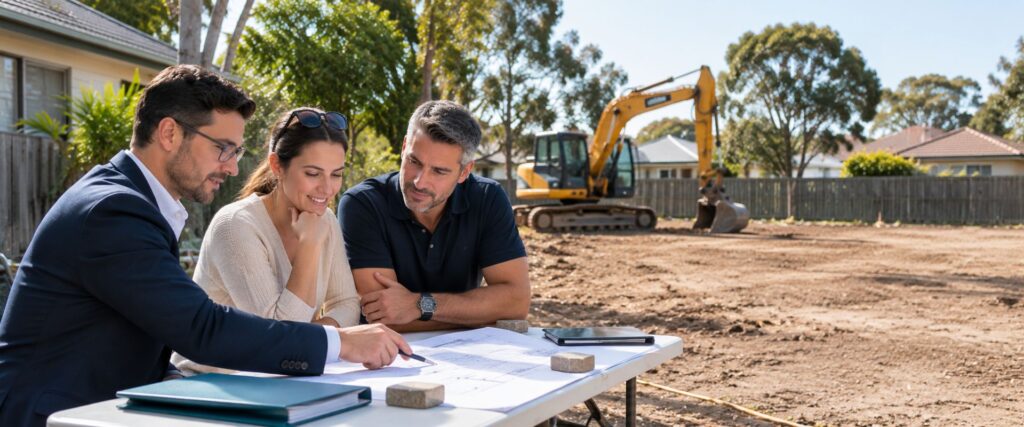
A renovation loan improves an existing building. Knock down rebuild finance removes it. For a few months the lender’s security is a vacant block worth considerably less than the house that stood on it, and the loan has to be structured around that gap.
In practice knock down rebuild finance is a construction loan. The existing mortgage is refinanced into it, or discharged and replaced, and the new facility funds demolition and the build in stages. Interest is charged only on what has been drawn.
A broker who writes knock down rebuild finance regularly will know which lenders fund demolition and which expect it paid first, which is the difference that decides your cash flow. Our Sydney construction home loan broker page sets out the process.
Once the build reaches practical completion the facility converts to an ordinary principal and interest home loan. That conversion is automatic with most lenders, but the rate it converts to is worth asking about before you sign.
If you are weighing the two structures against each other, the construction loan versus home loan comparison sets out how the drawdown and interest differ.
Knock down rebuild finance is assessed on two numbers, and borrowers who only know one of them get a nasty surprise. The first is the land value once the house is gone. The second is the on-completion value of the finished home.
Lenders size knock down rebuild finance against the on-completion figure, usually to eighty per cent of it, less whatever is still owing. The land value matters because it sets the floor on the security during the months the block is empty.
The on-completion valuation is done from the plans and the fixed price building contract, not from what you hope the house will be worth. A valuer who disagrees with your expectation reduces the loan, not the build.
This is where most rebuilds are won or lost on paper. Equity in the existing property usually covers the shortfall, and the usable equity calculation decides whether it stretches.
Published rebuild prices are build costs. They are not project costs, and knock down rebuild finance has to cover the project. The gap between the two is routinely a hundred thousand dollars or more in Sydney.
| Cost | Typical Sydney range | Note |
|---|---|---|
| Demolition, single storey | $15,000 to $35,000 | Add $5,000 to $10,000 for a pool, granny flat or heavy concrete |
| Asbestos removal | $5,000 to $20,000 and up | Common in anything built before the late 1980s |
| Site works, flat block | $10,000 to $20,000 | Retaining on a slope can run $30,000 to $80,000 |
| Council and approvals | $5,000 to $20,000 DA | A Complying Development Certificate is usually faster and cheaper |
| Design and reports | $13,000 to $48,000 | Design fees plus specialist reports |
| Build contract | $2,000 to $2,800 per sq m volume | $3,000 to $4,500 and up for a custom builder |
| Landscaping, driveway, fencing | $30,000 to $80,000 | Almost never inside the builder contract |
| Contingency | 10 to 15 per cent of project cost | Lenders increasingly expect to see it |
Figures are indicative Sydney ranges as at November 2026 and move with block, builder and scope. Treat them as a planning frame, not a quote.
For the build-cost side in detail, the Sydney knockdown rebuild cost guide breaks the numbers down by inclusion.
Knock down rebuild finance releases funds in stages against work completed, not in advance. Each stage needs an inspection before the lender pays the builder, and the builder invoices the lender directly rather than you.
The usual sequence runs deposit, slab, frame, lock-up, fit-out and practical completion. The percentage at each stage comes from the building contract, so it varies between builders and is worth reading before you sign anything.
Demolition sits awkwardly in that sequence. Some lenders fund it as a first draw, others expect it paid from your own cash before the construction facility begins. Knock down rebuild finance is one of the few products where that answer differs lender by lender.
The mechanics of each release are the same as any build, and the progress payments explainer walks through what the inspector is checking at each stage.
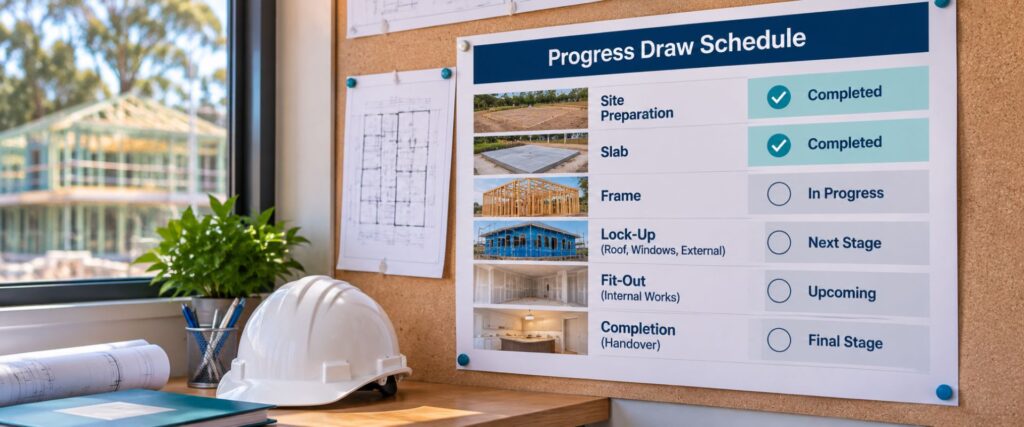
The common planning error is assuming knock down rebuild finance starts paying on day one. It usually does not. Several costs land before the construction facility is drawn at all.
Design fees, the DA or Complying Development Certificate, specialist reports and often the demolition itself are paid before the first progress draw. On a Sydney project that is frequently fifty to eighty thousand dollars of your own money.
Rent is the cost people forget entirely. You are housing the family somewhere for the duration of the build while still paying interest on the drawn balance. Twelve to eighteen months of rent belongs in the budget.
Serviceability is tested at a buffer above the actual rate, which is why borrowing capacity for a rebuild looks tighter than people expect. The serviceability buffer explainer covers how that assessment works.
Three failures account for most of the rebuilds that stall, and all three are visible before demolition if anyone looks.
The first is a low on-completion valuation. The loan is sized against that figure, so a valuer who comes in under the expected number leaves a funding hole that has to be filled with cash at the worst possible moment.
The second is variations. Every change to the contract after the valuation changes the cost without changing the approved loan. Lenders will not quietly top up a facility mid build, and construction cost overruns are the most common reason a build pauses.
The third is time. Approvals and rate changes both move during a long project, and an approval obtained eight months before demolition may no longer reflect what you can borrow.
Yes, and most people do. The existing mortgage is either refinanced into the construction facility or discharged and replaced by it. What matters is the on-completion value against the total debt, not the fact that a loan already exists.
The equity sitting in the property is usually what funds the deposit, the demolition and the approval costs before the first progress draw is released, which is how most knock down rebuild finance is structured in practice.
For almost every lender, yes. The on-completion valuation is produced from the plans and the contract, so a cost plus arrangement with no fixed total leaves the valuer nothing firm to work from.
A handful of lenders will consider cost plus for experienced builders or high net worth borrowers, but the loan is harder to structure and the conditions are tighter. A fixed-price contract is the simpler path.
It depends on the lender, and this is worth settling before you commit. Some fund demolition as the first progress draw on the construction facility. Others treat it as a precondition and expect it paid from your own funds or from a separate equity release before the facility begins.
On a Sydney knockdown that is fifteen to thirty five thousand dollars sitting in a different place in the cash flow depending on who you borrow from.
Plan on twelve to eighteen months from demolition to handover for a standard volume build, and longer for a custom home or a difficult block. Approvals add time before that, though a Complying Development Certificate is usually much faster than a development application.
Knock down rebuild finance matters here because you are paying interest on the drawn balance and rent elsewhere for the whole period, which is a real cost that belongs in the budget from the start.
No. The house is being demolished, so you need somewhere else to live for the duration. This is the cost most rebuild budgets miss entirely.
Twelve to eighteen months of rent in Sydney is a substantial figure and lenders will often ask how you intend to cover it while also servicing the drawn balance on the construction loan, because both are running at the same time.
Sometimes, and it depends almost entirely on what you already own. You keep the land and the location, and you avoid stamp duty on a new purchase, which is a significant saving in New South Wales.
Against that you carry rent, interest during construction and the risk of variations. The answer is specific to your block and your numbers rather than general.
Approval pathways, whether a development application or a Complying Development Certificate applies, and the lodgement process are all set out on the NSW Planning Portal. Which pathway your block qualifies for changes both the timeline and the approval cost, so check it before you budget.
Paritosh Wadhwani | Director and Principal Broker, APW Finance
Member of the Finance Brokers Association of Australia (FBAA). Arranging residential, commercial and specialist lending for Sydney clients across a panel of more than 50 lenders.
APW Finance Pty Ltd, 304/20a Lexington Drive, Bella Vista NSW 2153. Email: info@apwfinance.com. Phone: +61 447 959 546.
ACN 620 646 479 | ABN 79 620 646 479
This guide is general information only. It does not take into account your objectives, financial situation or needs, and it is not financial or credit advice. Lending criteria, interest rates, duty thresholds and government schemes change, and every application is subject to lender approval.
Consider whether this information suits your circumstances and seek independent advice before acting. Figures quoted are current at the date below and should be confirmed before you rely on them. Last reviewed: November 2026.
APW Finance Pty Ltd delivers expert lending solutions with personalised service, empowering clients across residential, commercial, and business sectors.