
On this page
Construction loan cost overruns are a routine feature of a Sydney build rather than a sign something has gone wrong, and the facility you signed was approved against a fixed contract sum. That mismatch is where the trouble starts.
The loan does not stretch. Increasing it is a fresh assessment, a new valuation of the on-completion value, and time you may not have before the next progress payment falls due.

Construction loan cost overruns come in two forms. They arrive the same way, as a claim or an invoice from the builder, and a lender handles them quite differently, so they are worth separating from the start.
The first is a variation you ask for. A change of finish, an extra window, a different benchtop. That is a change of scope, documented as a variation to the contract.
The second is a cost increase the builder passes on under the contract. A rise in material prices, a site condition discovered after excavation, or a provisional sum that comes in above the allowance.
Both increase what you owe the builder. Only the first is something you chose, which is why provisional sums deserve attention before you sign rather than after.
Four routes deal with construction loan cost overruns, and the order matters: the two that need no new lending are both the cheapest and the fastest.
| Route | What it needs | How long it takes |
|---|---|---|
| Pay from your own funds outside the loan | Cash available now | Immediate, and the usual answer for a modest variation |
| Increase the construction loan | A written variation, a revised on-completion valuation and a fresh assessment | Weeks, and it has to be approved before the next draw |
| Draw on equity in another property | Equity, and a separate application against that property | Weeks, and it keeps the construction facility untouched |
| Reduce the scope instead | Agreement with the builder, documented as a variation down | Quick, needs no lender approval, and the option people consider last |
Construction loan cost overruns are easiest to handle when the conversation happens before the work is done. A variation approved by the lender before it is built is a process. The same variation discovered at the next inspection is a problem.
Time is the second source of construction loan cost overruns. Construction facilities carry a build period, commonly twelve months, within which the work is expected to be finished and the loan converted.
Passing it is not automatic grounds for the lender to withdraw, and it is not automatic approval either. An extension has to be requested and documented, usually with a revised programme from the builder and an explanation of the delay.
During construction you are typically paying interest-only on what has been drawn, so a longer build means more months of interest before the loan converts to principal and interest.
That is a real cost of delay and it rarely appears in anyone’s budget. See the interest-only calculator.
The practical protection against construction loan cost overruns is money held outside the loan, in your own funds, before the slab goes down.
How much is a judgement rather than a formula, and it depends on how many provisional sums sit in your contract and how much of the site is unknown. A sloping block with no soil test is a different proposition from a flat one that has been built on before.
Where a contingency is not possible, that is worth knowing before the build starts rather than at the second draw. It may change which contract you sign or how much of the scope you commit to now.
We would rather raise it early than deal with it later, and we will say so plainly if the figures look thin. See the guide to building in Sydney.
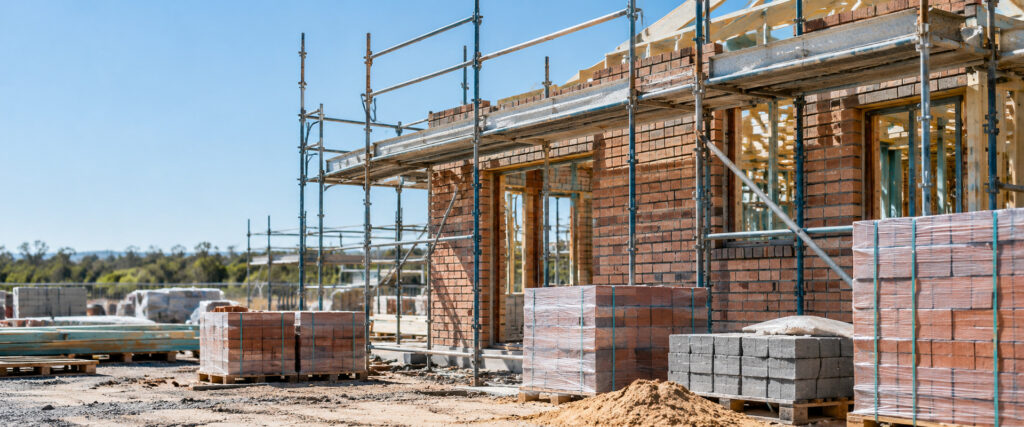
Most of the protection against construction loan cost overruns is bought at contract stage rather than managed later.
A fixed-price contract with few provisional sums is the single biggest factor. Every provisional sum is an allowance rather than a price, and each one can come in high.
A soil test and a survey before the contract is signed remove two of the most common site surprises. Both cost money up front and both are cheaper than discovering rock after excavation.
A full specification, down to fittings and finishes, removes the variations you would otherwise request mid-build. Those are the overruns you choose, and they are the easiest to prevent.
And a realistic programme. A build period that was always optimistic turns into an extension request, with more months of interest during construction. See construction loans against standard home loans.
This is the hardest version of construction loan cost overruns and it needs separating from a cost increase, because the remedies are different.
A change of builder mid-build is treated by a lender as a material change. Expect a new contract, new insurances, and a valuation of the work completed to date before any further draw is released.
Home building compensation cover exists in NSW for defined events, including a builder’s insolvency, and is generally required where the contract price exceeds twenty thousand dollars including GST. It carries its own eligibility rules and limits.
That is an insurance question rather than a lending one, and the detail belongs with the insurer and your lawyer.
What we can do is work with the lender on the facility while that runs its course. Your contract and the cover are matters for your lawyer and the insurer. Call +61 447 959 546 or see construction lending.
The facility does not stretch to meet it. You either fund the difference from your own money, apply to increase the loan, draw on equity in another property, or reduce the scope by agreement with the builder.
An increase means a documented variation, a revised on-completion valuation and a fresh assessment, so it takes weeks rather than days.
Through an increase to the existing construction loan in most cases, which the lender treats as a new application on the revised contract sum.
It needs the written variation or the builder’s claim, the contract clause relied on, and a revised valuation of the completed value. Getting it approved before the work is built is considerably easier than afterwards.
You agree it with the builder, and the lender approves the funding of it. Those are two separate decisions and they can diverge, which is the trap.
Agreeing a variation with your builder does not commit the lender to fund it, so the sequence should be lender first where the money has to come from the loan.
An extension has to be requested and documented rather than assumed, usually with a revised programme from the builder and an explanation of the delay.
Passing the build period is not automatic grounds for the lender to withdraw, but it is not automatic approval either, and the extra months of interest during construction are a real cost.
Enough that a provisional sum coming in high does not stop the build, which is a judgement rather than a formula.
It depends on how many provisional sums are in your contract and how much about the site is unknown. A sloping block without a soil test carries more risk than a flat block that has been built on before.
The lender treats a change of builder as a material change, so expect a new contract, new insurances and a valuation of work completed before further draws are released.
Home building compensation cover exists in NSW for defined events, including insolvency, generally where the contract price exceeds twenty thousand dollars including GST, and it carries its own eligibility rules and limits. That is a matter for the insurer and your lawyer.
Home building compensation cover in NSW, including the events it covers and the contract value at which it is required, is explained by Service NSW. Construction facility terms and build periods are set by individual lenders and change without notice.
Paritosh Wadhwani | Director and Principal Broker, APW Finance
Member of the Finance Brokers Association of Australia (FBAA). Arranging residential, commercial and specialist lending for Sydney clients across a panel of more than 50 lenders.
APW Finance Pty Ltd, 304/20a Lexington Drive, Bella Vista NSW 2153. Email: info@apwfinance.com. Phone: +61 447 959 546.
ACN 620 646 479 | ABN 79 620 646 479
This guide is general information only. It does not take into account your objectives, financial situation or needs, and it is not financial or credit advice. Lending criteria, interest rates, duty thresholds and government schemes change, and every application is subject to lender approval.
Consider whether this information suits your circumstances and seek independent advice before acting. Figures quoted are current at the date below and should be confirmed before you rely on them. Last reviewed: October 2026.
APW Finance Pty Ltd delivers expert lending solutions with personalised service, empowering clients across residential, commercial, and business sectors.