
On this page
What is a comparison rate, and why does every advertised home loan carry two numbers instead of one? The second figure exists because a headline interest rate can be made to look good by moving cost into fees, and borrowers were being caught by it.
The comparison rate folds the rate and most of the fees into a single percentage calculated the same way by every lender. It is genuinely useful. It is also narrower than most people assume.
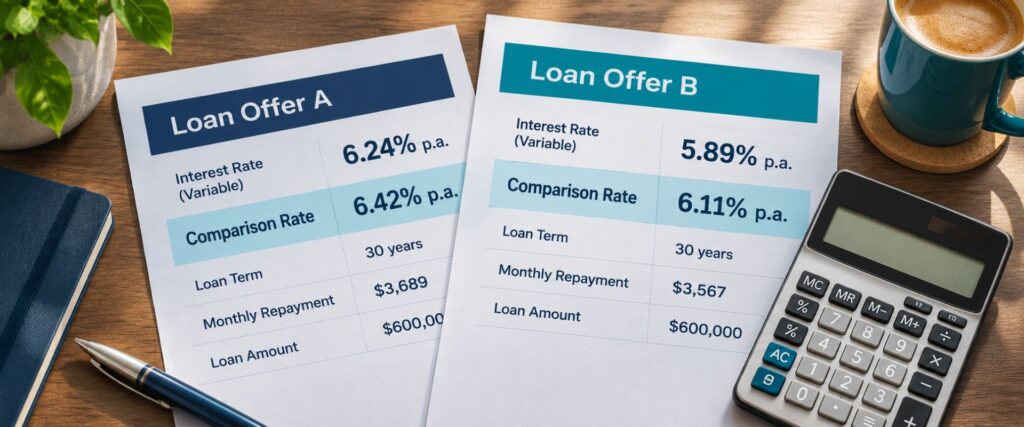
What is a comparison rate, in one line: the interest rate plus most of the fees and charges on a loan, expressed as a single annual percentage so two loans can be compared on one number.
The formula is not set by the lender. It comes from the Consumer Credit Code, which means every Australian lender calculates it the same way on the same assumptions. That consistency is the entire point.
Without it, a lender could advertise a very low rate and recover the difference through an annual fee, an application fee and a settlement fee, and the advertised number would tell you nothing useful.
So when someone asks what is a comparison rate, the short answer is that it is the regulated attempt to make advertised home loan pricing honest. What is a comparison rate not, is a quote.
What is a comparison rate calculated on? Every home loan comparison rate in Australia uses the same example: a secured loan of $150,000 over a term of 25 years. This is why the figure is comparable at all.
It is also the source of the warning attached to every advertised rate, which reads that the comparison rate is true only for the example given and may not include all fees and charges.
That warning is doing real work. A $150,000 example spreads fixed dollar fees across a small balance, so those fees weigh heavily in the percentage. On a Sydney loan several times that size, the same fees weigh far less.
The practical effect is that the comparison rate overstates the impact of fixed fees on a large loan. It is a ranking tool, not a quotation of what you will pay.
What is a comparison rate made of? The interest rate itself, and the fees that are known and unavoidable at the time the rate is quoted.
That means application and establishment fees, ongoing account or service fees, annual package fees where they apply, valuation fees charged by the lender, and settlement fees. These are the charges that would otherwise hide a high cost behind a low headline rate.
Understanding what is a comparison rate therefore means understanding that it is not purely an interest figure. Two loans at an identical headline rate can carry visibly different comparison rates, and the difference is fees.
If you want to run your own numbers against your actual loan size, the comparison rate calculator does it on your figures rather than the standard example.
This is where the answer to what is a comparison rate stops being complete, and where borrowers relying on it alone get caught.
| Excluded | Examples | Why it matters |
|---|---|---|
| Government charges | Stamp duty, mortgage registration | Real money at settlement, identical across lenders, so excluded |
| Fees for optional features | Redraw fees, early repayment fees | You may never use them, but if you do they are a real cost |
| Fees not knowable in advance | Charges that depend on your circumstances | Cannot be included because they are not yet determined |
| Cost-reducing features | Fee waivers, the benefit of an offset account | The biggest omission: a loan can be cheaper than its comparison rate suggests |
The last row is the one that does the most damage. An offset account can save a borrower with savings far more than a small rate difference, and none of that benefit appears in the comparison rate.
A loan with a higher comparison rate and a genuine offset can easily be cheaper in practice than a loan with a lower one and no offset.

Use it to rank, not to budget. What is a comparison rate good for is telling you which of two similar loans carries more fee load. It is unreliable as a prediction of what your loan will cost.
Compare like with like. A comparison rate on a fixed loan assumes the revert rate applies after the fixed period, so a low fixed rate with a high revert rate shows a comparison rate well above the headline. That is the number working as intended.
Then check the features separately. Offset, redraw, split facilities and repayment flexibility sit outside the calculation entirely, and for many borrowers they matter more than a tenth of a per cent.
The fixed versus variable comparison covers how the revert rate affects what you actually pay after the fixed term ends.
There are three situations where what is a comparison rate tells you points the wrong way, and all three are common.
The first is a large loan. Because the standard example is $150,000, fixed fees are overweighted. On a loan of eight hundred thousand or more, a difference in comparison rate driven by an annual fee is far smaller in reality than it appears.
The second is an offset account. The saving from parking an emergency fund and salary in an offset is invisible to the calculation and can easily exceed the rate difference between two loans.
The third is a short intended hold. The comparison rate assumes 25 years. If you expect to refinance in three, upfront fees weigh much more heavily than the figure suggests and ongoing fees much less.
If refinancing is the reason you are comparing, our Sydney home loan refinancing broker page covers what the switch actually costs.
Because it includes fees as well as interest. The comparison rate folds application fees, ongoing account or package fees, lender valuation fees and settlement fees into the percentage, so it will normally sit above the headline rate.
A large gap between the two is a signal that the loan carries a meaningful fee load, which is exactly what the figure exists to reveal. A small gap means fees are light. That spread is the whole of what is a comparison rate designed to expose.
No. It is a good first filter and a poor final answer. The calculation excludes the benefit of an offset account, any fee waivers, and the cost of optional features such as redraw or early repayment.
A loan with a slightly higher comparison rate and a genuine offset account can be substantially cheaper for a borrower who keeps savings in it, because that saving never appears in the published percentage at all.
The warning states that the rate is true only for the example given and may not include all fees and charges. It is there because the figure is calculated on a standard example of a $150,000 secured loan over 25 years.
Your loan is almost certainly a different size and term, so fixed dollar fees will weigh differently in your case. What is a comparison rate, in the end, is a ranking tool rather than a quote for your situation.
The example was set in the Consumer Credit Code to give every lender the same basis for the calculation, and it has not moved with property prices.
On a Sydney loan several times that size, fixed dollar fees spread across a much larger balance and therefore affect the real cost far less than the percentage implies. The comparison rate consistently overstates fee impact on large loans for this reason.
Yes, and it is often noticeably higher than the fixed rate advertised. The calculation assumes the loan reverts to the lender’s standard variable rate after the fixed period and runs the full 25 years on that basis.
A very low fixed rate attached to a high revert rate will therefore show a comparison rate well above the headline figure, which is the number doing its job rather than a fault in it.
No. Government charges including stamp duty and mortgage registration fees are excluded, because they are set by the state rather than the lender and are the same whichever lender you choose.
They are still real money payable at settlement and they belong in your cash budget. Excluding them simply keeps the comparison focused on the differences between one lender and another.
An independent walk-through of how to compare loan offers, including the features the comparison rate leaves out, is in the ASIC Moneysmart guidance on choosing a home loan. Read it alongside the advertised rates rather than instead of them.
Paritosh Wadhwani | Director and Principal Broker, APW Finance
Member of the Finance Brokers Association of Australia (FBAA). Arranging residential, commercial and specialist lending for Sydney clients across a panel of more than 50 lenders.
APW Finance Pty Ltd, 304/20a Lexington Drive, Bella Vista NSW 2153. Email: info@apwfinance.com. Phone: +61 447 959 546.
ACN 620 646 479 | ABN 79 620 646 479
This guide is general information only. It does not take into account your objectives, financial situation or needs, and it is not financial or credit advice. Lending criteria, interest rates, duty thresholds and government schemes change, and every application is subject to lender approval.
Consider whether this information suits your circumstances and seek independent advice before acting. Figures quoted are current at the date below and should be confirmed before you rely on them. Last reviewed: November 2026.
APW Finance Pty Ltd delivers expert lending solutions with personalised service, empowering clients across residential, commercial, and business sectors.